
Based on the PEF (Product Environmental Footprint) method, developed by the scientific community under the aegis of the European Commission, Glimpact analyzes the impact of any product with regard to 16 environmental impact categories: climate change, fine particle emissions, depletion of water resources, depletion of non-renewable fossil and mineral resources, land use, ozone depletion, soil acidification, ionizing radiation, photochemical ozone formation, terrestrial, marine and freshwater eutrophication, human carcinogenic and non-carcinogenic toxicity, freshwater eco toxicity...
For each of these, impact characterization methods are precisely defined and apply to all stages of the product life cycle (from raw materials to end-of-life). Finally, the PEF method weighs the results for these different impact categories to obtain an overall, understandable environmental score - the only one worth having, as it enables organizations or products to be compared objectively with each other.
As of April 25, 2024, this scientifically rigorous calculation method is the only one recognized for all European Union countries in terms of environmental footprint and eco-design.
No more self-proclaimed environmental claims. No more possibility of claiming ecological responsibility based on a single environmental criterion. No more room for greenwashing: no more simplistic prejudices, partial analyses, and hasty judgments made without understanding the magnitudes involved. No more hiding certain stages of a product's life. By modeling the requirements of the PEF method, Glimpact provides companies, journalists, and citizens with tools to measure environmental impact comprehensively, without any blind spots.
With the widespread adoption of the PEF method as the reference framework for the new European regulations, there is now one single method for calculating the environmental footprint of products and organizations for all countries in the EU. Finally, there is a single scientifically rigorous method that takes into account the overall environmental footprint in all dimensions, allowing us to understand planetary boundaries.
.png)

Measuring impact on a global scale overturns many simplistic prejudices and hasty judgments, established without any perception of orders of magnitude. Looking at things globally, for example, makes it possible to realize that contrary to what we may think:
⁃ that a PET plastic bottle has a much lower environmental impact than a single-use glass bottle (due to the amount of energy required to remelt the glass)
⁃ that almond-based "plant milk" has a much higher impact than cow's milk (mainly due to the amount of water needed to produce almonds).
⁃ that it's not transport (even from Asia) that is responsible for the environmental impact of a garment but above all the fiber used to produce it and certain industrial processes, foremost among which are dyeing or even weaving.
⁃ that in summer in Madrid, it's better to eat French tomatoes than Spanish ones (due to the water stress affecting a large part of Spain's agricultural regions).
In short, the right trade-offs cannot be based on simplistic judgments, but require an analysis that takes into account all the components of the environmental crisis.
Find out more about the methodological framework ➞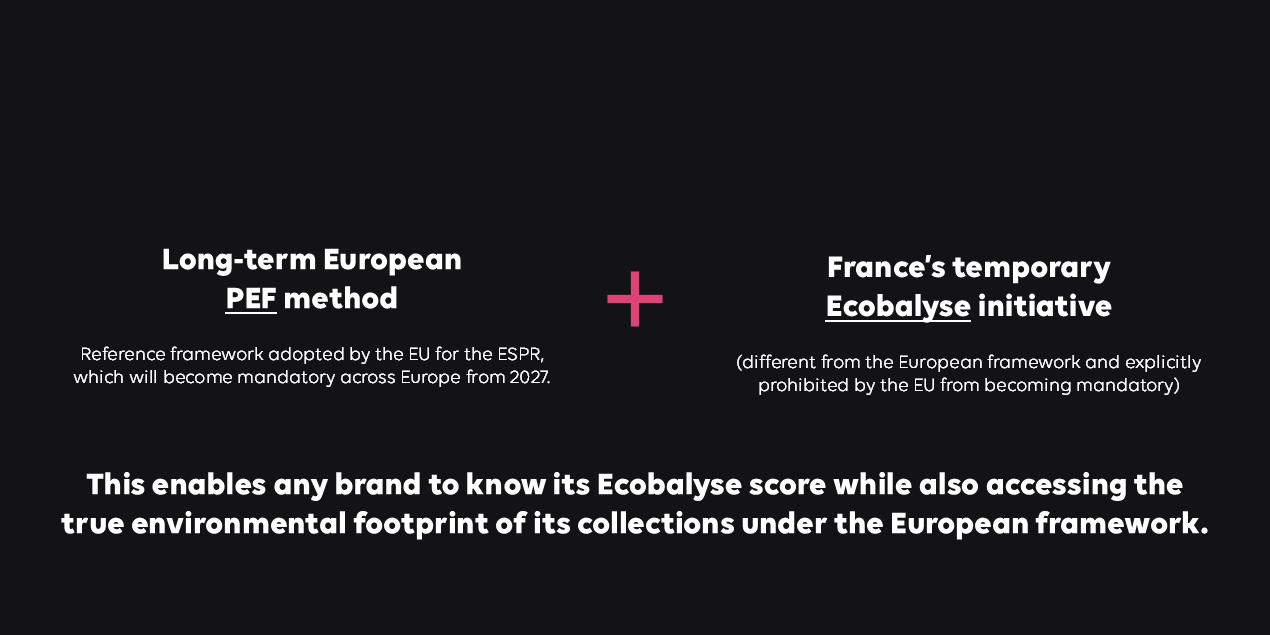
The fashion and textile sector is currently at a regulatory crossroads, facing an unprecedented methodological duality.
On the one hand, France has implemented since 1 October 2025 its voluntary environmental labelling scheme Ecobalyse, which diverges significantly from the European framework and whose mandatory application was explicitly prohibited by the European Commission. This scheme, which does not account for physical durability, relies on a database of default values (for materials and processes) and does not allow brands to introduce their own specific primary data. The French decree also stipulates that, starting from 1 October 2026, any third party will be able to publish the Ecobalyse score of any brand’s collections that have chosen not to do so themselves, using publicly available data.
On the other hand, the European Commission has validated the PEFCR Apparel & Footwear sectoral benchmark, based on the PEF method, which constitutes the sole scientific reference framework for implementing the ESPR regulation on product eco-design, a regulation that will become mandatory around 2027.
This complex situation exposes industry players to two distinct methodological frameworks that also lead to different results and different eco-design levers, making the planning of their environmental transition all the more challenging.
How should companies position themselves for voluntary labelling in France while mastering the European methodological framework that will ultimately prevail, in order to prepare for the implementation of the ESPR regulation, which will become mandatory for the apparel sector around 2027?
To help you immediately engage in your ecological transition, prepare confidently for the implementation of the ESPR regulation and turn it into an opportunity, while keeping full control over the Ecobalyse score of your collections, Glimpact offers both methodological frameworks on a single platform, addressing the key challenges with the following advantages:
To give you the best possible access to these essential solutions, Glimpact offers three promotional offers valid until 31/12/2025:
Feel also free to contact us and we will be happy to schedule a meeeting.
